Selected themes and examples from applied mathematics, nanoscale modelling, and mathematical physics.
Overview
My research focuses on the modelling of nanoscale structures, devices, and materials
using classical applied mathematical techniques. This page highlights several themes
that have shaped that work.
The emphasis is on mathematical modelling, geometric structure, continuum methods,
and analytical techniques that help explain or predict behaviour in nanoscale systems.
Nanoscaled Oscillating Systems
Nanoscaled oscillating systems are of interest because of their potential use in
ultra-high-frequency devices. Mathematical models of fullerene and nanotube-based
oscillators can help identify stable configurations, predict frequencies, and
understand the influence of geometry on device performance.
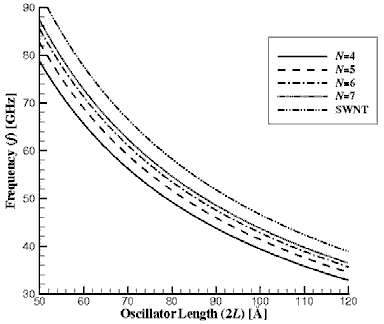
Frequency for a fullerene nanotube bundle oscillator for various configurations
and for a fullerene oscillating in a single-walled carbon nanotube.
Geometry of Nanostructures
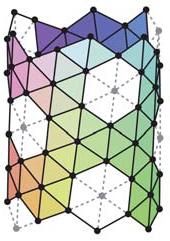
Many nanoscale structures exhibit cylindrical, spherical, or spheroidal forms.
Because energetic constraints often favour symmetric conformations, geometrical
reasoning can simplify otherwise complex molecular problems and lead to results
that are both mathematically tractable and physically informative.
By assuming appropriate symmetry at the outset, it is often possible to derive
useful predictions for idealised systems and novel structures in limiting cases.
Geometric ideas can reduce complex molecular structure problems to more
tractable mathematical models.
Electrorheological Fluids
Electrorheological fluids provide an example of how mathematical modelling can
illuminate the behaviour of particulate systems under externally applied fields.
In particular, modelling the Winslow effect helps describe how particle interactions
change under electric loading and how that affects the macroscopic response of the fluid.
Such questions connect continuum modelling, particle interaction forces, and the
design of materials with unusually large field-induced yield stresses.
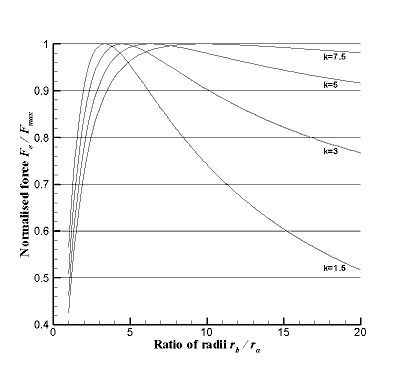
Comparison of mutual force for touching spheres under varying dielectric assumptions.
Modelling Nanoscale Devices Using Continuum Mechanics
Even at very small length scales, classical continuum mechanics can remain useful.
One example is the modelling of intermolecular interaction forces between carbon
nanotubes, where continuum approximations can replace computationally expensive
pairwise calculations by surface-integral formulations.
In favourable cases, these integrals can be reduced to analytical expressions
involving hypergeometric functions and related special functions.
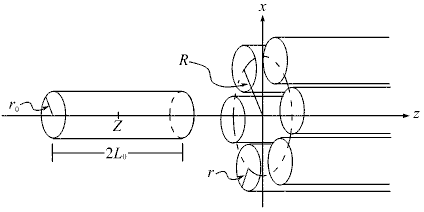
Geometry for a single nanotube entering a nanotube bundle.
Predicting Properties of Nanomaterials
The joining of carbon nanostructures such as nanotubes, graphene sheets, and
fullerenes is central to the design of many novel nanoscale devices.
These joins are fundamentally geometric, and they can be studied by minimising
deviations in bond lengths and bond angles from ideal configurations.
Variational ideas are also useful here: one can seek join configurations that
minimise total curvature squared subject to other structural constraints.
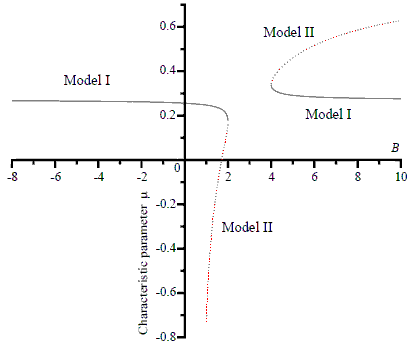
Relationship between parameters when joining two fullerenes.